
Key Takeaways
- Nahuatl was the language of the Aztecs and their ancestors, serving as a sophisticated linguistic vessel for cultural expression and spiritual understanding
- The serpent symbol, particularly Quetzalcoatl (the Feathered Serpent), held profound cosmological significance in Nahuatl culture as a mediator between realms
- Aztec art and jewelry often incorporated serpent imagery as talismans to connect wearers with divine forces and cosmic energy
- Serpents represented duality in Nahuatl philosophy – embodying both creation and destruction, life and death, wisdom and transformation
- Modern sterling silver jewelry continues this ancient tradition, preserving Nahuatl symbolism through contemporary craftsmanship
- Handcrafted pieces like our Quetzalcoatl Pendant honor this rich cultural heritage while making it accessible to modern admirers
- The serpent's ability to shed its skin made it a powerful metaphor for rebirth and renewal in cyclical Aztec cosmology
Introduction to the Nahuatl-Speaking Peoples
The Nahuatl language resonates through time as the voice of one of Mesoamerica's most influential civilizations. Spoken by the Aztecs (Mexica) and their ancestors, Nahuatl wasn't just a communication tool but a complex linguistic system that captured the essence of a sophisticated worldview. These peoples, who established the mighty city of Tenochtitlan in what is now Mexico City, developed a rich cultural tradition where language, art, and spirituality intertwined to create a comprehensive understanding of the universe and humanity's place within it.
The Nahuatl-speaking peoples traced their origins to the mythical place of Aztlan, from which they migrated southward to the Valley of Mexico. Their society developed into a complex civilization with advanced agricultural techniques, monumental architecture, and a sophisticated understanding of astronomy and mathematics. At the heart of this civilization was their language—Nahuatl—which served as the foundation for their cultural identity and became the medium through which they expressed their profound philosophical concepts. The language itself contained intricate metaphorical structures that reflected their nuanced understanding of reality and the cosmos.


The Quetzalcoatl Pendant shown above represents one of the most significant deities in Nahuatl culture. Crafted in solid 925 sterling silver with handcrafted intricate detailing, this pendant embodies the artistic traditions that have been passed down through generations. The Nahuatl-speaking peoples viewed such symbols not just as decorative but as connections to divine forces, imbued with sacred energy that could bridge the gap between the human and divine realms. These objects were considered living entities in their own right, capable of channeling cosmic power.
The Aztec Empire, at its height in the 15th and early 16th centuries, spread Nahuatl throughout Mesoamerica as a lingua franca. Even after the Spanish conquest, Nahuatl remained important, with many indigenous communities continuing to speak various dialects of the language today. This linguistic resilience mirrors the enduring nature of Aztec cultural symbols, particularly the serpent, which continues to inspire modern interpretations in jewelry and art. The persistence of Nahuatl linguistic elements in modern Mexican Spanish further demonstrates how deeply this cultural heritage has embedded itself in the contemporary cultural landscape of Mexico and beyond.
Nahuatl: A Vessel for Myth, Art, and Philosophy
Nahuatl transcended its function as a mere communication tool to become a sophisticated vehicle for transmitting the complex mythological, artistic, and philosophical traditions of the Aztec civilization. The language itself was poetic and metaphorical, rich with compound words that conveyed layered meanings and nuanced concepts that reflected their understanding of the cosmos. Scholars have noted that Nahuatl's linguistic structure, with its ability to build complex concepts through word compounding, perfectly mirrored the Aztec understanding of reality as interconnected and multidimensional.
In Nahuatl poetry and song, known as "in xochitl, in cuicatl" (the flower, the song), we find profound philosophical reflections on existence, truth, and the nature of reality. These weren't simply aesthetic expressions but vehicles for preserving and transmitting cultural wisdom. The tlamatinime, Nahuatl philosopher-poets, used metaphorical language to explore concepts of duality, time, and the relationship between humans and divine forces. Their sophisticated rhetorical techniques employed parallelism, difrasismo (paired metaphors), and other poetic devices to express complex philosophical ideas about the transitory nature of earthly existence and the pursuit of truth in a world of illusion and change.


The Aztec Face Signet Ring shown above captures the essence of Nahuatl artistic expression. Based on the famous Aztec Sun Stone (Piedra del Sol), this solid silver piece represents the Aztec calendar and cosmological understanding. Each element in this design had specific meaning in Nahuatl culture, reflecting their sophisticated system of timekeeping and their cyclical view of history. The concentric circles represent different cosmic eras or "suns," while the central face depicts Tonatiuh, the sun deity who required sacrificial offerings to continue his journey across the sky, sustaining cosmic order through the cycles of day and night.
Nahuatl art was never merely decorative—it was functional, educational, and deeply symbolic. Codices painted on amate paper or deerskin used pictographic writing to record history, religious practices, and astronomical observations. Stone sculptures, ceramics, and metalwork all incorporated a visual language that communicated complex ideas about the cosmos, often featuring serpent imagery as a central motif. These artistic expressions served multiple purposes simultaneously: recording knowledge, teaching cultural values, connecting with divine forces, and reinforcing social structures through visual representations of cosmic order. The integration of text and image in Nahuatl codices demonstrates their holistic approach to knowledge, where visual and verbal elements worked together to convey meaning.
The intricate designs in our Aztec jewelry collection draw inspiration from these ancient artistic traditions, preserving the symbolic language that was so integral to Nahuatl expression. Each piece tells a story, continuing the Nahuatl tradition of embedding meaning into visual form. By wearing these pieces, modern individuals can connect with this rich cultural heritage and carry forward the sophisticated symbolic language that the Nahuatl-speaking peoples developed to express their understanding of the cosmos and humanity's place within it.
The Serpent's Significance in Nahuatl Cultural Framework
In the Nahuatl worldview, the serpent occupied a position of supreme importance, embodying fundamental cosmic principles and divine forces. The Nahuatl word "coatl" (serpent) appears prominently throughout their mythology, art, and religious symbolism, representing transformation, wisdom, and the cyclical nature of existence. Archaeological evidence from sites throughout central Mexico demonstrates that serpent symbolism predated the Aztec civilization by thousands of years, suggesting its deep roots in Mesoamerican cosmological understanding and its enduring significance across multiple cultural periods.
The serpent's ability to shed its skin made it a powerful symbol of renewal and rebirth in Nahuatl thought. This natural phenomenon resonated deeply with the Aztec conception of time as cyclical rather than linear, where endings gave way to new beginnings in an eternal cosmic dance. The serpent thus became a living metaphor for their understanding of how the universe functioned. Aztec philosophers observed how the serpent emerged renewed from its old skin, seemingly reborn while maintaining its essential nature – a perfect natural symbol for their concept of cosmic cycles where destruction led inevitably to recreation in an endless process of renewal that maintained the balance of opposing forces.


Our Quetzalcoatl Gold Skull Pendant captures this profound symbolism in luxurious form. Priced at $1,069.00, this handcrafted piece in solid 925 sterling silver combines the serpent imagery with the skull motif, another powerful Nahuatl symbol representing the cyclical nature of life and death. The intricate detailing reflects the careful artistry that characterized Aztec craftsmanship. The gold plating pays homage to the Aztecs' reverence for precious metals, which they associated with the sun and divine power. Every curve and scale in this design has been carefully considered to represent the symbolic language through which the Nahuatl peoples expressed their cosmic understanding.
In Nahuatl cosmology, serpents were associated with the boundaries between different realms. They were seen as creatures that could traverse the heavens, the earth, and the underworld, making them mediators between humans and divine forces. The feathered serpent, in particular, represented this ability to bridge different cosmic domains, combining earthly and celestial attributes. This concept of boundary-crossing made serpents particularly significant in religious contexts, where priests sought to communicate with divine forces across cosmic boundaries. The sinuous movement of serpents further reinforced their association with water, another element that flowed between and connected different realms in Nahuatl cosmology.


Our collection includes other significant Nahuatl deities like Tlaloc (the rain deity) and Mictlantecuhtli (lord of the underworld), but the serpent-related imagery, as seen in our Quetzalcoatl Gemstone Pendant, remains among the most powerful and enduring symbols from Nahuatl culture. Each of these deities represented different aspects of cosmic forces, but they were interconnected in the complex pantheon that structured Nahuatl religious understanding. The relationships between these deities mirrored the interconnected nature of cosmic forces in Nahuatl thought, where no single element could be understood in isolation from the greater whole.
Quetzalcoatl: The Feathered Serpent Deity
Among the pantheon of Nahuatl deities, none captures the imagination quite like Quetzalcoatl, the Feathered Serpent. His name itself is a perfect example of Nahuatl compound word formation: "quetzalli" (the emerald-green feathers of the quetzal bird) combined with "coatl" (serpent), creating a powerful linguistic and visual metaphor for a deity who embodied both earthly and heavenly attributes. This linguistic construction exemplifies how Nahuatl compound words often brought together seemingly opposite elements to express complex philosophical concepts about the unity underlying apparent duality.
Quetzalcoatl's significance in Nahuatl mythology can hardly be overstated. He was credited with creating humanity, discovering maize (corn), inventing the calendar, and bringing knowledge and civilization to the people. As a cultural hero and god of learning, priesthood, and wisdom, Quetzalcoatl represented the highest aspirations of Nahuatl civilization. Historical records indicate that different Mesoamerican cultures revered this deity under various names for over a thousand years before the Aztec period, demonstrating the profound and enduring impact of this symbol on Mesoamerican thought. The deity's association with the morning star (Venus) further connected him with cycles of disappearance and return that reinforced his role as a symbol of transformation and renewal.


Our Quetzalcoatl Garnet Pendant ($619.00) pays homage to this revered deity. Crafted in solid 925 sterling silver and featuring a rich garnet stone, this handcrafted piece captures the essence of Quetzalcoatl's dual nature. The intricate detailing showcases the serpentine form adorned with feather-like elements, reflecting the sophisticated artistic traditions of Nahuatl culture. The deep red garnet symbolizes the life-giving blood that was so central to Aztec religious concepts, where blood sacrifice was seen as necessary to maintain cosmic order and fertility. Each scale and feather has been carefully rendered to honor the artistic traditions that developed over centuries of Mesoamerican civilization.
In Nahuatl mythology, Quetzalcoatl engaged in an eternal cosmic struggle with Tezcatlipoca (Smoking Mirror), representing the duality that was fundamental to Aztec thought. This conflict between light and darkness, creation and destruction, wisdom and sorcery, embodied the complex philosophical understanding of opposing yet complementary forces that governed the universe. According to various myths, these deities took turns destroying and recreating the world through successive cosmic ages or "suns," demonstrating how even apparent opposition ultimately served the greater cosmic order. This sophisticated philosophical concept found expression not just in myths but in ritual practices, artistic representations, and social structures throughout Nahuatl society.


The Quetzalcoatl Pendant ($189.00) represents another interpretation of this important deity. This solid silver piece features the distinctive serpentine form with feathered elements that defined Quetzalcoatl's iconography in Nahuatl art. Wearing such a piece connects the wearer to the ancient wisdom and transformative power that Quetzalcoatl represented in Nahuatl culture. The pendant's design draws on archaeological evidence from various Mesoamerican sites, where Quetzalcoatl imagery appears in stone carvings, codices, and ceramic vessels. By translating these ancient artistic traditions into wearable form, this pendant allows modern individuals to carry forward this powerful symbol of wisdom and transformation.
Serpent Symbolism in Nahuatl Art and Architecture
The serpent motif permeated virtually every aspect of Nahuatl visual expression, from monumental architecture to personal adornment. This widespread presence reflected the central role that serpent symbolism played in their cosmological understanding and religious practices. Archaeological evidence from sites throughout the Aztec empire and earlier Mesoamerican civilizations reveals the consistent presence of serpent imagery across different media and contexts, demonstrating its fundamental importance to their visual language and symbolic system.
Perhaps the most striking architectural expression of the serpent in Nahuatl culture was the Great Temple (Templo Mayor) in Tenochtitlan, where twin staircases were flanked by massive serpent heads at their base. These sculptural elements represented the sacred mountain Coatepec ("Serpent Mountain" in Nahuatl), the mythical birthplace of the war god Huitzilopochtli. The entire temple complex served as a cosmic map, with the serpent imagery marking boundaries between different realms. Excavations at the Templo Mayor site have revealed multiple construction phases, each preserving and elaborating on the serpent symbolism, demonstrating how central this imagery remained throughout the development of Tenochtitlan as the Aztec imperial capital. The architectural alignment of these serpent sculptures with celestial phenomena further reinforced their role in connecting earthly and cosmic domains.


While not specifically serpent-themed, our Aztec Skull Ring ($259.00) represents another important symbol in Nahuatl iconography. In Nahuatl culture, skulls represented the cyclical nature of life and death—concepts that were also associated with serpent symbolism. This solid 925 sterling silver piece captures the intricate carving style that characterized Aztec stone sculptures. The skull motif appeared prominently in Aztec religious contexts, particularly in the tzompantli (skull racks) that displayed the skulls of sacrificial victims. These displays weren't viewed as macabre by the Aztecs but as sacred assemblages that honored those who had given their lives to maintain cosmic order through the offering of their life essence.
Serpent imagery appeared prominently in Nahuatl codices, pottery, and personal adornments like jewelry. Elite members of Aztec society wore elaborate ornaments featuring serpent motifs as symbols of their status and connection to divine power. These weren't merely decorative but served as physical manifestations of their cosmological beliefs and social hierarchy. Excavations at offerings within the Templo Mayor have uncovered numerous examples of serpent-themed jewelry and ornaments, often crafted from precious materials like gold, jade, and obsidian. These objects combined aesthetic beauty with profound symbolic meaning, demonstrating the sophisticated integration of art and religious thought in Nahuatl culture.


Our Aztec Eagle Helmet pendant ($469.00) represents another important symbol in Nahuatl military culture. Eagle warriors (cuāuhtli) were elite soldiers who, along with the jaguar warriors (ocēlōtl), formed the most prestigious military orders in Aztec society. While not serpent-themed, this piece demonstrates the broader symbolic language of Nahuatl culture that our jewelry collection preserves. The eagle, like the serpent, had significant symbolic associations in Nahuatl thought – particularly connected to the sun and celestial realm. The eagle's ability to soar toward the sun made it an appropriate symbol for elite warriors who sought to capture sacrificial victims to feed the sun deity and maintain cosmic order through ritual offerings.
The Dual Nature of Serpents in Nahuatl Thought
In Nahuatl philosophy, duality was a fundamental concept that structured their understanding of the cosmos. The serpent, with its complex symbolism, perfectly embodied this principle of duality—representing both creative and destructive forces, life and death, earth and sky, male and female aspects of existence. This philosophical concept of duality wasn't viewed as conflict or contradiction but as complementary aspects of a unified cosmic whole, where apparent opposites were understood as different manifestations of the same underlying reality. Nahuatl philosophers developed sophisticated metaphorical language to express these concepts, often using paired terms (difrasismo) to convey meanings that transcended simple binary oppositions.
The Nahuatl word "coatlicue" (serpent skirt) was the name of the earth goddess who gave birth to the moon, stars, and Huitzilopochtli, the sun and war god. Her fearsome representation, adorned with serpents and wearing a skirt of writhing snakes, captured this dual nature—she was both the nurturing mother earth and the terrifying devourer who required blood sacrifice to sustain cosmic order. The famous Coatlicue monolith discovered near the Templo Mayor presents one of the most striking visual expressions of this dual nature, with its combination of life-giving and death-dealing attributes. Her serpent skirt represents both the fertility of the earth and the constant cycle of death and rebirth that characterized Nahuatl understanding of cosmic processes.


Our Mictlantecuhtli Pendant ($189.00) represents the Nahuatl lord of the underworld, another deity associated with this concept of duality. In Nahuatl cosmology, Mictlantecuhtli ruled Mictlan, the lowest level of the underworld, yet was essential to the cycle of life, death, and rebirth. This solid silver pendant captures the skeletal features and distinctive headdress that characterized this important deity in Nahuatl iconography. Archaeological evidence from sites like the Templo Mayor includes numerous representations of Mictlantecuhtli, demonstrating his importance in Aztec religious practice. Despite his fearsome appearance, he wasn't viewed as evil but as a necessary cosmic force who governed an essential realm in the Nahuatl cosmological structure.
The serpent also represented the boundary between order and chaos in Nahuatl thought. The cosmic serpent Cipactli, whose body formed the earth in Aztec creation myths, embodied both the primordial chaos from which the ordered world emerged and the structured cosmos itself. This paradoxical nature reflected the sophisticated philosophical understanding that characterized Nahuatl thought. Nahuatl philosophers recognized that creation necessarily emerged from destruction, that order required an initial chaos, and that these apparent opposites were fundamentally interconnected rather than truly separate. This philosophical insight informed not just their mythology but their approach to politics, warfare, agriculture, and other aspects of social life.


Our Tlaloc Pendant ($349.00) represents another important deity in the Nahuatl pantheon. As the god of rain, lightning, and earthly fertility, Tlaloc embodied the dual nature of water—life-giving in proper amounts but destructive in excess. In Nahuatl art, Tlaloc was often depicted with serpentine elements, reflecting the association between serpents and water in their symbolic language. The distinctive goggle-eyed face and fanged mouth of Tlaloc appeared consistently across centuries of Mesoamerican art, demonstrating the enduring importance of this deity. Archaeological evidence from mountain shrines dedicated to Tlaloc reveals how the Aztecs conducted rituals at high elevations to communicate with this deity, seeking to ensure beneficial rains for agricultural fertility.
Serpents in Nahuatl Creation Myths
Serpent imagery features prominently in Nahuatl creation myths, underscoring the creature's fundamental importance to their cosmological understanding. These myths reveal how the serpent symbol was interwoven with concepts of creation, destruction, and cosmic renewal. The detailed accounts preserved in colonial-era documents like the Florentine Codex provide valuable insights into how the Nahuatl-speaking peoples conceptualized cosmic origins and the ongoing processes that maintained universal order.
In one of the most significant Nahuatl creation accounts, the primordial earth monster Cipactli (sometimes depicted as a crocodilian creature with serpentine aspects) floated on the primeval waters. The creator deities Quetzalcoatl and Tezcatlipoca transformed themselves into serpents to tear this creature apart, using its body to form the earth and sky. This violent act of creation established the fundamental duality of the cosmos in Nahuatl thought. The myth demonstrates how creation and destruction were viewed as interconnected aspects of the same cosmic process, with the serpent form representing the transformative power necessary to convert primordial chaos into ordered reality. The sacrifice of the primordial being to create the world established a pattern that justified human sacrifice as a necessary continuation of the original creative act.


The Quetzalcoatl Gold Skull Pendant combines two powerful Nahuatl symbols—the feathered serpent and the skull—that were central to their creation myths. This luxurious piece, priced at $1,069.00, embodies the profound symbolic language through which the Nahuatl-speaking peoples understood cosmic origins and the cyclical nature of existence. The combination of the creative force (Quetzalcoatl) with the symbol of death (the skull) perfectly captures the Nahuatl understanding that creation and destruction were complementary rather than opposed forces. The meticulous craftsmanship evident in this pendant honors the sophisticated artistic traditions through which these complex philosophical concepts found visual expression.
Another important creation myth involved Quetzalcoatl's journey to Mictlan, the underworld, to retrieve the bones of previous human generations. After obtaining these bones, he sprinkled them with his own blood, bringing humanity to life. This myth established Quetzalcoatl's role as the creator of the current human race and emphasized the serpent deity's function as a mediator between cosmic realms. The myth demonstrates how serpent symbolism was associated with the ability to traverse different cosmic domains, connecting the world of the living with the realm of the dead. It also established blood sacrifice as essential to creation, a concept that would be central to Aztec religious practice. The self-sacrifice of Quetzalcoatl's blood to create humanity established a pattern that humans would later follow in their ritual offerings to maintain cosmic order.


While our Hunnya Mask Ring ($309.00) represents Japanese rather than Nahuatl symbolism, it demonstrates how powerful cultural symbols transcend specific traditions. Like the serpent in Nahuatl culture, masks in various traditions often represent transformation and the ability to cross between different states of being. This cross-cultural parallel highlights how different human societies have developed similar symbolic languages to express profound concepts about transformation and the fluid boundaries between different aspects of existence. The craftsmanship evident in this piece demonstrates our commitment to honoring diverse cultural traditions through meticulous attention to authentic details.
The Serpent in Nahuatl Divination and Ritual
Serpent symbolism was deeply embedded in Nahuatl religious practices, particularly in divination systems and ritual performances. The creature's association with knowledge, transformation, and cosmic power made it central to how the Nahuatl-speaking peoples communicated with divine forces. Priests and diviners trained for years to master the complex symbolic systems through which cosmic knowledge could be accessed and interpreted, with serpent imagery playing a key role in these specialized practices.
In the Nahuatl calendar system, one of the twenty day signs was Coatl (Serpent), associated with those born under this sign having attributes of wisdom and cunning. The Tonalpohualli, the 260-day divinatory calendar, incorporated serpent imagery throughout its complex system of day counts and associated deities, demonstrating how fundamental this symbol was to their understanding of time and fate. Specialized priest-diviners known as tonalpouhque consulted codices filled with serpent imagery to interpret the cosmic influences affecting individuals born on particular days. These divinatory practices weren't viewed as superstition but as sophisticated methods for understanding the cosmic forces that shaped human destiny and determining appropriate ritual responses to maintain harmony with these forces.
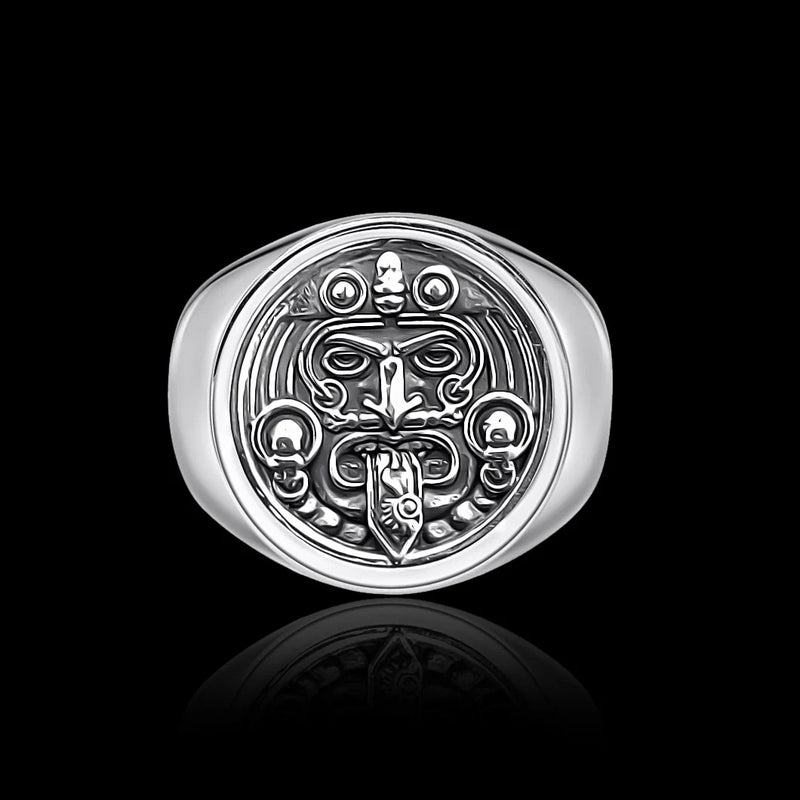

Our Aztec Rings collection includes pieces inspired by these calendar symbols and sacred imagery. Each design connects to the rich symbolic language that structured Nahuatl ritual life, allowing modern wearers to carry these powerful symbols with them. The Sun Stone design references the Aztec calendar system with its complex mathematical precision and cosmological significance. The Quetzalcoatl design incorporates the feathered serpent imagery that was so central to Nahuatl religious iconography. By translating these ancient symbols into wearable form, our collection allows contemporary individuals to connect with the profound symbolic language through which the Nahuatl peoples understood cosmic forces and their influence on human life.
Serpent imagery featured prominently in Nahuatl ritual objects and ceremonial attire. Priests and nobles wore serpent-themed ornaments during religious ceremonies, physically embodying the connection between human and divine realms. The serpent's transformative power was invoked in rituals related to healing, fertility, and communication with the gods. Archaeological evidence from ritual caches and tombs includes numerous examples of serpent-themed objects used in religious contexts, from elaborate headdresses to handheld ritual implements. These objects weren't merely decorative but were understood as having agency and power, capable of facilitating communication between human and divine realms when used in appropriate ritual contexts by properly trained religious specialists.


The Aztec Eagle Helmet pendant represents the ceremonial attire worn by elite Aztec warriors. While not serpent-themed, it demonstrates how symbolic objects were used in Nahuatl culture to transform the wearer, connecting them to divine powers and ancestral traditions. Eagle warriors underwent rigorous training and ritual initiation before earning the right to wear such regalia in battle and ceremonial contexts. The helmet transformed the warrior into a manifestation of eagle attributes – keen vision, swift movement, and connection to solar power. This transformation wasn't viewed as symbolic but as an actual metaphysical change that occurred through proper ritual procedures and the power inherent in the sacred objects themselves.
Modern Interpretations of Nahuatl Serpent Symbolism
The powerful serpent imagery from Nahuatl culture continues to resonate in contemporary art, literature, and personal adornment. Modern interpretations of these ancient symbols allow people to connect with this rich cultural heritage while expressing their appreciation for its profound philosophical and artistic traditions. In Mexico particularly, pre-Columbian symbolism has experienced various revivals throughout the 20th and 21st centuries as part of broader movements to reclaim and celebrate indigenous cultural heritage in the face of colonial legacies.
Contemporary jewelry designers, including our artisans at Serpent Forge, draw inspiration from Nahuatl serpent symbolism to create pieces that honor these traditions while making them accessible to modern wearers. These aren't mere reproductions of ancient designs but thoughtful reinterpretations that capture the essence of Nahuatl symbolic language. Our design process involves extensive research into archaeological evidence and historical sources to ensure that our pieces authentically represent the sophisticated symbolic systems developed by the Nahuatl-speaking peoples. At the same time, we adapt these designs for contemporary wear, creating pieces that are both meaningful and practical for modern contexts.


Our Quetzalcoatl Pendant ($189.00) and Quetzalcoatl Gemstone Pendant ($619.00) represent different interpretations of this important Nahuatl symbol. Each piece is handcrafted in solid 925 sterling silver, maintaining the high-quality materials and craftsmanship that characterized Aztec metalwork while adapting the designs for contemporary wear. The intricate detailing in these pieces reflects our commitment to honoring the sophisticated artistic traditions developed by Nahuatl artisans. Every curve, scale, and feather element has been carefully considered to authentically represent the visual language through which the feathered serpent deity was traditionally depicted, while adapting these elements for the technical requirements of modern jewelry production.
In Mexico and beyond, Nahuatl serpent imagery has become an important symbol of cultural identity and heritage. These symbols connect modern individuals to ancestral traditions and express pride in the sophisticated artistic and philosophical legacy of pre-Columbian Mesoamerica. By wearing jewelry inspired by these traditions, people participate in keeping this cultural memory alive. The revival of interest in pre-Columbian symbolism reflects broader movements toward cultural reclamation and the recognition of indigenous contributions to world heritage. For those with Mesoamerican ancestry, these symbols can represent a connection to ancestral wisdom and cultural resilience in the face of historical trauma. For others, they offer an opportunity to appreciate and learn from sophisticated philosophical and artistic traditions that developed independently from European influence.

